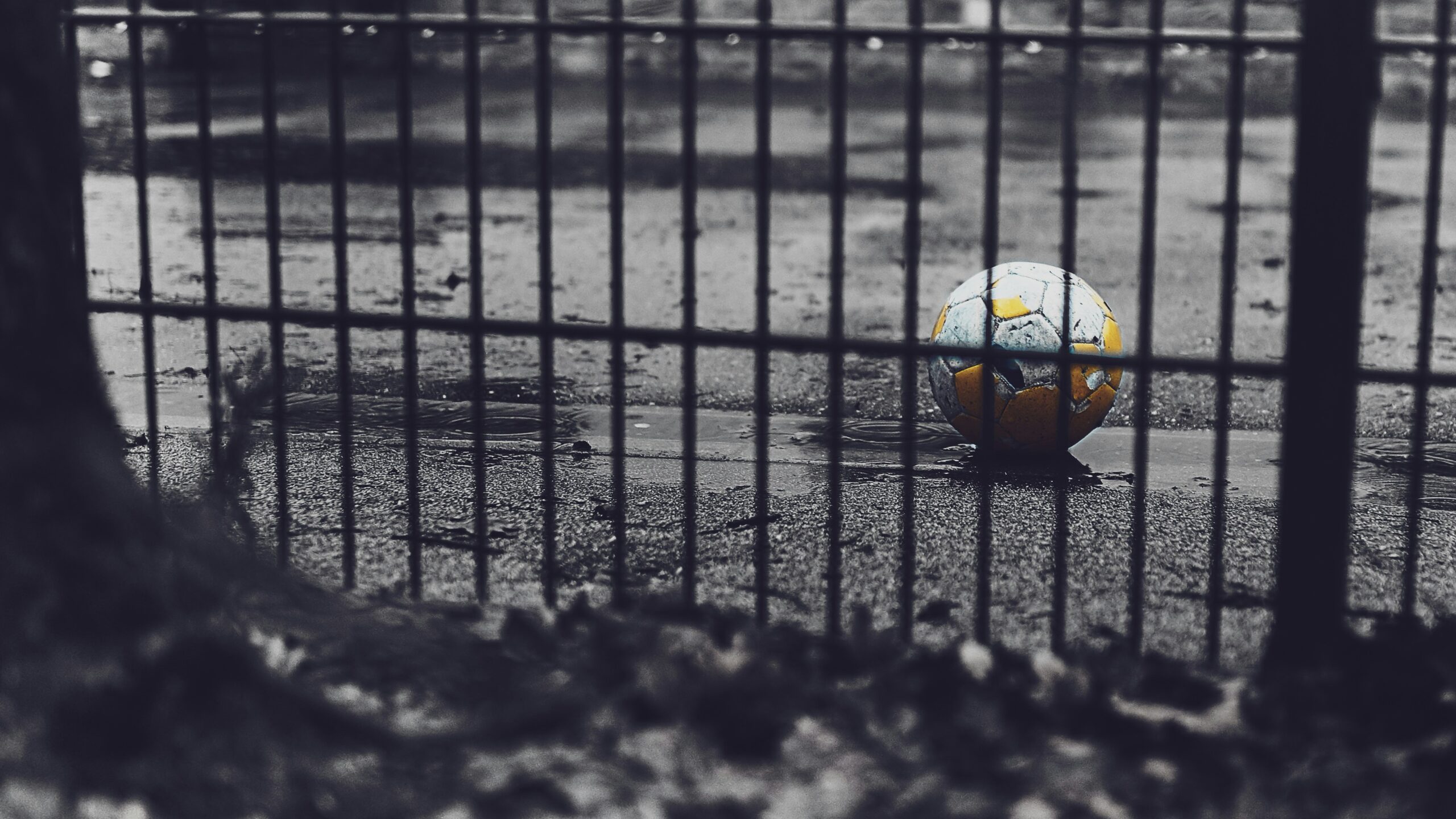
“But that’s not fair!” I cried.
June 22nd, 1994. A day that would live in infamy forever, for my 4th-grade teacher, Mr. Patterson, refused to give me the highly anticipated new blue raspberry-flavored Blow Pop he’d promised the class at the end of the day because I “wasn’t staying the whole day.”
“It’s not my fault my dad’s picking me up early!”
He didn’t budge, and I trudged to the office, defeated and deprived of the sweet lollipop victory I’d earned for having survived an entire school year with Mr. Patterson.
“Ready to go, sweetie?”
“I guess so.”
My dad told me he was picking me up early for a soccer game.
I would’ve rather had a Blow Pop.
Driving away from school, I imagined us going to some field with no shade that was too hot, and I’d eat my way through the entire orange slice supply in thirty minutes. When we merged onto the freeway, I was confused. All the soccer games I knew about were AYSO, and that league was for little kids like me and all near our house in Chula Vista.
“Why are we getting on the freeway?”
“We’re going to Pasadena. It’s about three hours away,” he said. “If we don’t hit bad traffic,” he mumbled to himself.
I wondered why we’d go so far for some soccer game, but it was something I rather would’ve pondered with a sucker in my mouth working my way to the bubble gum in the middle.
I’d been on long drives before, but I don’t think I’d been to Pasadena. When things started to look unfamiliar, I seethed over all my classmates who would’ve devoured their delicious Blow Pops by now. Then, we turned off the freeway.
Finally. We were there!
Nope.
Instantly, we were in the longest line of cars I’d ever seen. It wrapped around a corner with no end in sight. But there was something interesting in sight I’d never seen.
“Why do people have signs in their yard saying ‘$20’?”
“It’s for parking.”
“$20 for parking?!’
“Oh yeah. It’ll get even higher the closer we get.”
“The closer we get to what? The soccer game??”
“Other places call it ‘fútbol,’ not ‘soccer,’ and a ‘game’ is a ‘match,’” he said, “and yeah, it’s a big deal.”
A “fútbol” “match?” A big deal? Those must be some good orange slices to charge $20.
“It’s called ‘The World Cup.’”
I could hear my dad getting excited, but “The World Cup” meant nothing to me. You know what would? A Blow Pop.
“It’s kind of like the Olympics,” he went on. “On that scale, I mean. It involves a lot of other countries.”
“The Olympics? Like the rings and metal and all that stuff?”
“Exactly.”
I was more confused than ever. Ok, so, we were going to a “fútbol” match that was three hours away, that was basically the Olympics, where they charged $20, well now, $40 for parking, and this is why I had to sacrifice a Blow Pop?
As we slugged past $100 lawns, my dad became serious.
“Before we get in there, there’s something you need to know.”
I hoped that what I “needed to know” was that he’d bought Blow Pops.
But no.
“Some people take soccer very seriously.”
News to me.
“Why?”
“It’s a big source of pride for their country.”
Huh.
“If things start to get scary,” Dad reassured, “just stay very close to me and, if it gets too scary, we’ll leave.”
Scary? It was soccer, not Freddy Kruger. What could be so scary about a bunch of guys running around, hardly making any goals?
Dad also said, “This is also one of the biggest stadiums in the world.”
I didn’t know my dad to be dramatic, but this seemed excessive.
“The world?”
“The world,” he said with what I would later know was wonder.
We didn’t have to pay $100 for parking because we had some fancy pass that let us park on a golf course, which I found funny. The closer and closer we got to the entrance, the more people crowded me, and I took my dad’s hand.
When I was brave enough to look around, I realized I’d never seen so many American flags used for so many different things. Hats and shirts, sure, but now there was every piece of clothing I knew how to identify made from Old Glory, and even things I didn’t know, like a scarf that people wore lazily; I later learned was called a “bufanda.”
There was merchandise that had red, white, and blue all over it too, like “Striker, The World Cup Pup,” whose merch I would’ve rather had. More than any Blow Pop. But it cost about as much as a good parking spot, and that was ridiculous.
Everything I remember until we got to our seats were a lot of people’s flagged torsos and butts that made me feel like I should say the Pledge of Allegiance. But there’s no way I’d risk losing my dad’s hand by putting my own hand over my heart. I pledged allegiance to the flag, but more so, to my dad.
When we got to our seats, my dad sat behind the taller of the two men wearing yellow, blue, and red shirts in front of us, but I still couldn’t see anything, so he let me stand on my chair, but “just until more people get here.”
When I raised my head after getting my balance, all I saw was green. Vibrant green. Clear, fresh green. Sharp green. Green that you didn’t see naturally in Southern California. Green like the grass knew its purpose and worth, even though I didn’t.
Everything else around us was red, white, blue, and yellow. The green was special. Its own. It was powerful. So strong, it even made the men standing on it look small. It was infinitely bigger than any of us, besides the bowl that held us, of course.
“Wow,” I sighed out, “that’s a big field.”
“Pitch,” my dad informed, “in soccer, it’s called ‘the pitch.’”
The men in front of us must have been having the same conversation.
“Impresionante,” one of the yellow-shirt men said.
“Sí,” responded the other.
“Enorme,” added my dad.
The two yellow-shirt men turned to see my dad, a white American, eavesdropping and interrupting their conversation, but also appreciating the same sight and speaking Spanish. For a moment, I thought they’d be annoyed by him and his cliché invasion. Instead, their faces brightened, their arms spread and they high-fived my dad while calling him something I recognized, “gringo.”
My dad asked, “Sorprendido?”
“Sí! Sí!” They laughed.
I knew even less than my dad, but knew enough to tell the man in front of me, “Me gusta tu camisa.” I said “shirt” because I didn’t know how to say “jersey.”
“Camisa? No, no, mija, esto es un kit.”
“’Kit’? ‘Kit’ means jersey?”
“Yes and no,” my dad explained, “A jersey is the shirt the players wear and, in soccer, that’s called a ‘kit,’ instead of a jersey, but for other sports, it’s still called a ‘jersey.’”
Geez, I thought learning one other language was hard enough, now it was two different languages in two different languages! I needed a notepad to remember all of this. “Soccer” was “fútbol,” a “game” was a “match,” a “scarf” was a “bufanda” but only a certain kind of scarf, the “field” was a “pitch,” a “jersey” was a “kit,” I wondered what they called a headache.
From there, I listened to my dad and people known as “Colombians” have a conversation in Spanish. I knew my dad wasn’t fluent, and it didn’t take the Colombians long to figure it out either, but regardless of a smaller vocabulary, they made each other laugh and chatted away about the pitch and “fútbol” and the stadium. At least I think they did.
I stayed mesmerized by the pitch until more people started crowding in and I had to sit down, but then I had to stand up again when we sang the National Anthem with almost 100,000 people. It felt different than it usually did. I don’t know why, but my dad must’ve felt it too because I could’ve sworn I saw him mess with his contact lens.
The match started and the pitch was so much bigger than an AYSO game. Which made it even more boring! The players ran so much just to turn around and run back the other way again. How could they run that much anyway? The crowd around me would get tense and hold their breath, but then they’d groan and relax, and all the red, white, blue, and yellow kits just kept running and running.
Even still, it was fun watching my dad laugh with other Colombians who showed up around us while the other white people seemed confused by the red, white, blue, and yellow interaction.
The heat plus boredom had me nodding off when something felt like it screeched in my ear and made my entire tiny body vibrate from the outside, all the way in. I couldn’t control my shaking heart, and thought I might be dying. I reached out for my dad’s hand, and he took it.
“What – happened?” I yelled up to him like we were in front of a jet engine.
“It – was – an own – goal!”
“A what?” I wasn’t sure if it was still the jet engine or another “fútbol” term I didn’t know.
“He scored – a goal – for the wrong – team!” Ok, soccer term.
“Who did?”
“Andrés Escobar!”
“Is that – our – guy?”
“No!”
One of the Colombians had his head in his hands and the other had his hand over his mouth. They didn’t move for a second. Then they turned and looked at each other and said something without words. I didn’t know what it was, but it seemed really bad. My dad seemed to speak that language, too because he wasn’t cheering.
“So we get the point?”
“Yeah.”
I was about to start cheering when my dad but put a calm hand in front of me as a signal not to. I learned that you cheer when your own team does something well, but not when the other team does something poorly. Everyone playing is human, and the athletes already know they messed up. You could tell Escobar knew it because he seemed really distracted after that
Even still, what was the big deal? I’d scored an “own goal” against my team before in AYSO. Sure, it was embarrassing and yeah, it must be worse in front of so many people but what’s the worst that could happen? You lose the game? “You can’t win ‘em all” anyway.
The most important thing was that we’d scored and I learned that the sensation I’d felt throughout my body was what happens when we score. All those people got so loud that I couldn’t tell where I ended and they began. I wanted that feeling again, and I wanted to be ready for it next time. From that point, I was all in.
I cheered with everyone else while we watched USA battle Colombia.
I asked my dad if the men in front of us were from Colombia. When he said that they were, I was amazed someone would travel to another country to watch a soccer game. I mean, a “fútbol match.”
“They’re the favorites in this tournament,” my dad told me.
“Who? Us?” I expected.
“Colombia.”
Huh. I thought America was the favorite for everything. Football, baseball, basketball, I didn’t think other countries even had those sports. No matter, I knew that USA was going to win because they were the underdogs. Dogs. Like “Striker, the World Cup Pup” from the parking lot. USA always rises when we’re the underdogs.
After that, I held my breath with everyone else and groaned when that joyous payoff didn’t come again. While we red, white, and blue chanted, “U–S–A! U–S–A!” the Colombians realized they didn’t meet the same pentameter requirements. But did that stop their spirit? Of course not! We’d chant, “U–S–A! U–S–A!” and they’d turn back to us and chant, “Co–Lom–Bia! Co–Lom–Bia!” It made me laugh and they smiled with me. I liked them.
They poked fun at my dad when the US was doing well, and my dad would give one a nudge on the shoulder after Colombia had made a good play. The camaraderie was just as fun as the game, and it actually did feel like the Olympics. Like the opening games I’d watched on TV where everyone was proud and hopeful and, well, unified.
The next goal felt like slow motion. I realized we’d scored just a split second before everyone reacted and I took the opportunity to watch, not the players’ responses, but the response of the people. Starting with the elite at the bottom, everyone rose on their turn up to the thousandth nose-bleed ticket. Like a ripple of wind through a flag. Then, they exploded like a firework on the 4th of July.
The Colombians yelled to my dad with another word I knew, “Mierda!” and shook their heads.
But then, betrayal. No, mutiny. Treason! A yellow card was called on Alexi Lalas and deprived the US of their pride and privilege to rejoice, and the score was still 1-0.
Thankfully, the bountiful lord who everyone thanked when they won games, smiled on us because, oh man, it was great! It was like, pass, pass, and then Ernie Stewart had it but then it looked like the Colombian kit was going to be able to steal it from Ernie or at least trip him because he came up on the left. And then the goalie met him outside of the box so for sure they were gonna stop Ernie because you don’t leave the box like that unless you think your guy’s gonna get the ball.
But then! But then Ernie shot the goal past the goalie and it went in! It went in and no one could say it didn’t. It didn’t hit a post or anything, it just rolled right in there on the right side of the net. Well, on the left side but the correct side and anyway! He scored fair and square. No flags, no nothing. “Fair and square.” Because that’s what the USA was. I looked to my dad and he nodded to show me it was ok to cheer and I became a part of the sound.
Toward the end of the match, it didn’t really seem to matter when Adolfo Valencia scored for Colombia because it was too late for them. It wasn’t too late for my dad to clap the shoulders of the Colombians in front of us and congratulate them though.
USA, 2. Colombia, 1.
When the match ended, my dad shook hands with the Colombians around us and they gave me high-fives. It reminded me of AYSO when you had to walk the shame line and tell the other team, “Good game,” even though no one meant it. Only I was on the other side of it this time. My AYSO team had never won a game. Being the youngest in my family, I’d certainly never won. I’d never played anything where I’d won.
But now, I wasn’t a loser. I was an American! And America won! I’d cheered for a team and they’d won. I’d won. We’d won.
I took my dad’s hand to leave. Not out of fear but out of honor. I was skipping on the golf course where we’d been allowed to park with our special pass.
“Did you have fun, honey?”
“Yeah! We won!”
“Well, it should’ve been a draw.” I almost stopped skipping.
“A what?”
“A draw. It should’ve been 1-1.”
I didn’t understand.
“You mean like a tie??” Those didn’t exist in real life. Not in America, anyway. You might’ve gotten more time sometimes but at the end of it all, you were either a winner or a loser. That was it.
Why did my dad think we should’ve lost? Why didn’t he want us to be winners? The gears started turning my memory wheel about Escobar’s accidental goal, but I put a wrench in and said,
“Well, we won the game anyway.”
“Match. We won the match.”
“Yeah, match. That’s what I said.”
The red ribbon of endless tail lights guided us to the freeway. A beacon. One if by land, two if by sea. From sea to shining sea. Underdogs. USA. We won. I drifted off in the land of the free and the home of the brave, and slept soundly all the way home.
10 Days Later
My dad called me in from playing outside with an urgency reserved for a family emergency. Instead, his eyes didn’t move from the TV set to see me come in.
“Breaking news this evening. Andrés Escobar from the Colombian soccer team in this year’s FIFA World Cup, was shot dead upon his return home to Medellin.”
“What?!”
“Shh, shh.”
“The center-back was in a nightclub parking lot when a gunman opened fire six times, repeating ‘Gol’ after each shot. It’s assumed the motive is retaliation for Escobar’s own goal at the match against the US almost 2 weeks ago, which caused the Colombian team, a rumored favorite to win the tournament, to be eliminated. However, sceptics say it’s a clear sign of further corruption within the sport and a painful reflection on the state of Colombian life today.
Andrés Escobar was due to wed later this year. He leaves behind his fiancée, his brother, and his father.
Andrés Escobar. Dead, at 27.”
I couldn’t move. Neither could my dad. Another story came on and the reporter switched tones like a manic depressive.
Hot tears of devastation and anger slid down my cheeks.
“Why did they do that?! All he did was make a mistake! It was just a mistake! Everyone makes mistakes!”
“Remember how I told you some people take soccer really seriously?’
“But,” I couldn’t find the words. “But,” A man was dead. Murdered. Left to bleed out after someone had shot him while taunting him over an accident, as if Escobar had wanted to make an own goal. He died without his fiancée or his family around him. His life drained out, and he knew it was because of the one thing he’d done wrong instead of all the things he’d done right in his whole life. He knew it was because of the embarrassment and shame he’d caused his country. Because of one single soccer game. He knew it was because of a game.
“But that’s not fair!” I cried.