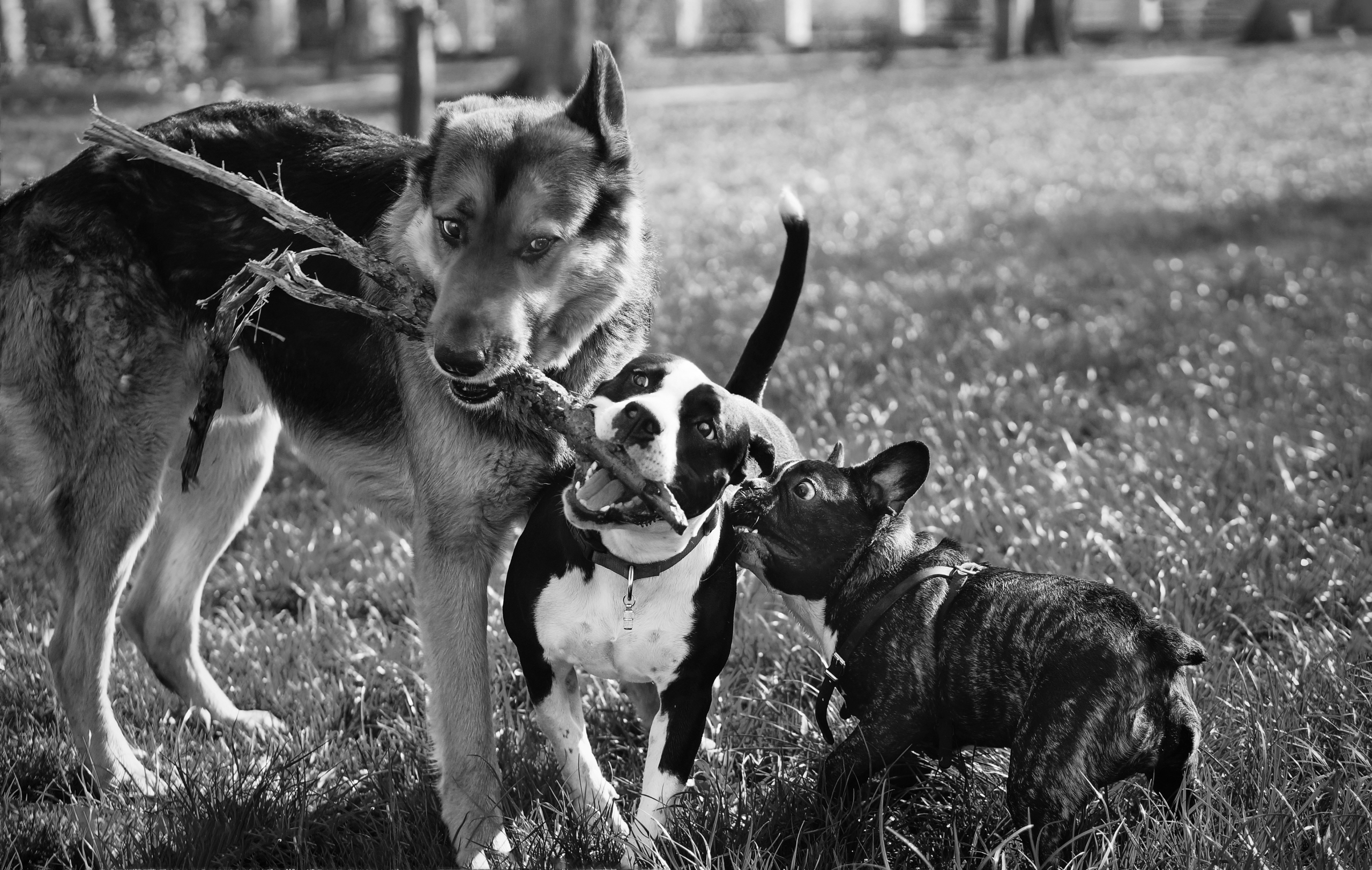
You don’t want to know what it’s like to house-sit three spoiled-rotten dogs all by yourself. You have to be on guard at all times. Those little critters your wife calls her “fur babies,” and that you love more than you’re willing to admit, are mischievous little buggers.
You usually never had problems when you lived by yourself, and you only had the one dog. The doggy love of your life. A black Miniature Schnauzer called “Herr Adler von Borinquen,” whom you credit for saving your life and a bunch of other superstitious, physics-law-breaking, serotonin-induced miracles that you attribute to how you felt when he stared at you, and you went off to interpret—as if he were Lassie—that he was communicating with you.
You had not taken him out for a walk; all he wanted was his walk, and there you sat, as if you were a character from the Bible, with a revelation that your dog gave you, all the while he was really trying not to pee where he sleeps, which is next to you.
At least he had the decency to wait for your egocentric delusions, and inadvertently assuage them.
When the second dog came along (his son!), you didn’t have the chance to train him. It was Covid, and Panama forbade people from taking their dogs out. This created a habit similar to one from your childhood: Easter egg hunting, only this time it was tiny little pellets of poop hidden in the most obscure places of your “maison.” Sometimes they chose to go nougat style. Sometimes it was chocolate fondue. It was always someplace unforgivable, and you cannot blame yourself for losing a little bit of your sanity during those prohibition days.
Oh, you also created this little game for yourself: poop-and-pee cartography. Drawing the exact position between the poops and the rivers of pee that formed between the colorful and boldly scented islands of poop, continents of furniture, chairs, the inside of your favorite shoe…
So what did you do? You went ahead and bought a third puppy. A Parson Jack Russell, a breed known for being, well, ask the British government how many irreplaceable antiques were destroyed by the one owned by former PM Boris Johnson. You picked that breed, one that gladly tagged along with the untrained chaos.
You called yours “Brexit.”
You considered yourself a masochist, mentally unstable, or both. Who in their right mind gets a third during a pandemic with one troublemaker already wreaking havoc and an older dog learning that he, too, could get away with it… and his son would get the blame? You knew it was going to be impossible to handle the little velociraptors, let alone train them yourself. All the good manners the old dog had had nothing to do with you, and everything to do with that beautiful (calling her this will get you in trouble with your wife, but she was, and the reader deserves the truth) and very Dutch unemployed ex-girlfriend you had at the time, who used all of her Nordic Pagan discipline (at least Pagan to you, a Latino in a toxic relationship with chaos) to train that first dog like he were to be shipped to Meghan Markle.
These little buggers you had to train yourself. You keep asking yourself why. Every work of art left by these dogs in your house is a tribute to how bad you are as a dog trainer.
And it escalates every time your wife leaves the house. It doesn’t matter how much you have spent cleaning and disinfecting and even changing furniture.
They have a map. You have a dog poop-and-pee cartography chart in your living room.
You better have some poop bags nearby.
And yet, for all your bickering as if you were an old Muppet in the opera balcony, you know deep inside that you don’t just love dem little furry vandals (for they do go Rastafari when you choose to spend their grooming cash on bringing down the credit card balance, and then complain about the smell and the strange stains they leave on the couch). You are obsessed, in love with them. The pandemic came and went. They remain. You spend hours marauding the Web for tips on their behavior, convincing yourself they’re miniature Mr. Miyagis teaching you to wax on and wax off your emotions. Deep down, you know they don’t really do that. You know that if they come toward you, it’s more often than not one of three: feed me, pet me, or watch that carpet turn from white to yellow. You know they are not fur babies. They are animals. And you know the most dehumanizing thing you can do is humanize them. They’re not prophets. They probably do smell the changes in your body when you’re stressed, but you did not train them to. But you don’t care about how the very well-researched rationale for dog reactions and realities works. You toss logic out the window just because the mutts are staring at you with deep, loving eyes, their brains fixed on the taste of those mini burgers you bought at Petco last week. And you, the Internet knowledge warrior, refuse to accept that: they are talking to you. You are special. You are different.
Loving dogs involves a contract nobody warns you about. It is a contract with the most beautiful and the most dreadful lessons of life. You sign up for joy, for unconditional love, for a connection that makes you believe that God is dog spelled backwards. And as alibis: everyone understands the pain of cleaning carpets, disinfecting cushions, mapping out where little digestive crimes occurred, thus needing to go home and walk them or look after them. They are the perfect excuse to leave early from those things you never want to go to in the first place. But what surprises you is how this contract forces you into the present. Into routine. Into care. Into the grit that keeps your feet on the ground when your head wants to float into existential orbit.
But you also sign up for the most painful of lessons: you know your dog will die before you. You know there’s nothing you can do about that. You stop and then reflect: is the chaos they cause really worth the pain you are signing up for? Or is it another life lesson, teaching you that nothing in this world is perfect, that Sisyphus and his rock aren’t really a tragedy, but a lesson about how life is what happens while you wait for the rock to fall off, and wait until your body loses the strength to carry it back up?
Time still scares you. You watch it trickle, always faster than you expect. Your older dog is alive and well, healthy and happy, and yet you have already chosen the song you will record with your guitar and sing with your own voice for the montage of pictures and videos you will make for his memorial. You think about this while he has a ball in his mouth, tail wagging, full of life. You even thought about it and cried when Oasis played on their reunion tour. The song is “Talk Tonight,” a thank-you ballad to someone who saves the singer’s life.
Maybe that’s the truth you never say out loud: you need chaos to feel alive. Without it, the emptiness gets too loud.
So you hold on to these small, bombastic critters. They become your hourglass. They remind you that meaning isn’t found. You birth it, just like they do with their annoying need for routines and accidents and tiny private miracles. There’s no x-ray for those moments. No chart that can capture them. Except maybe your ridiculous dog-poop cartography on the living room floor. Which you know you could probably fix, but somehow, you still don’t.
Nietzsche said something like, “One must have chaos within to give birth to dancing stars.” And maybe that’s why you choose dogs. The barking, the accidents, the wrestling tournaments, the occasional snout in the litterbox (yes, there are cats too, but that’s a story for another time). Because every one of those stupid, exhausting, infuriating moments is just another little dancing star that shines when the darkness arrives.
Then the chaos within begins to make sense. You’re probably still mad. But it feels right.