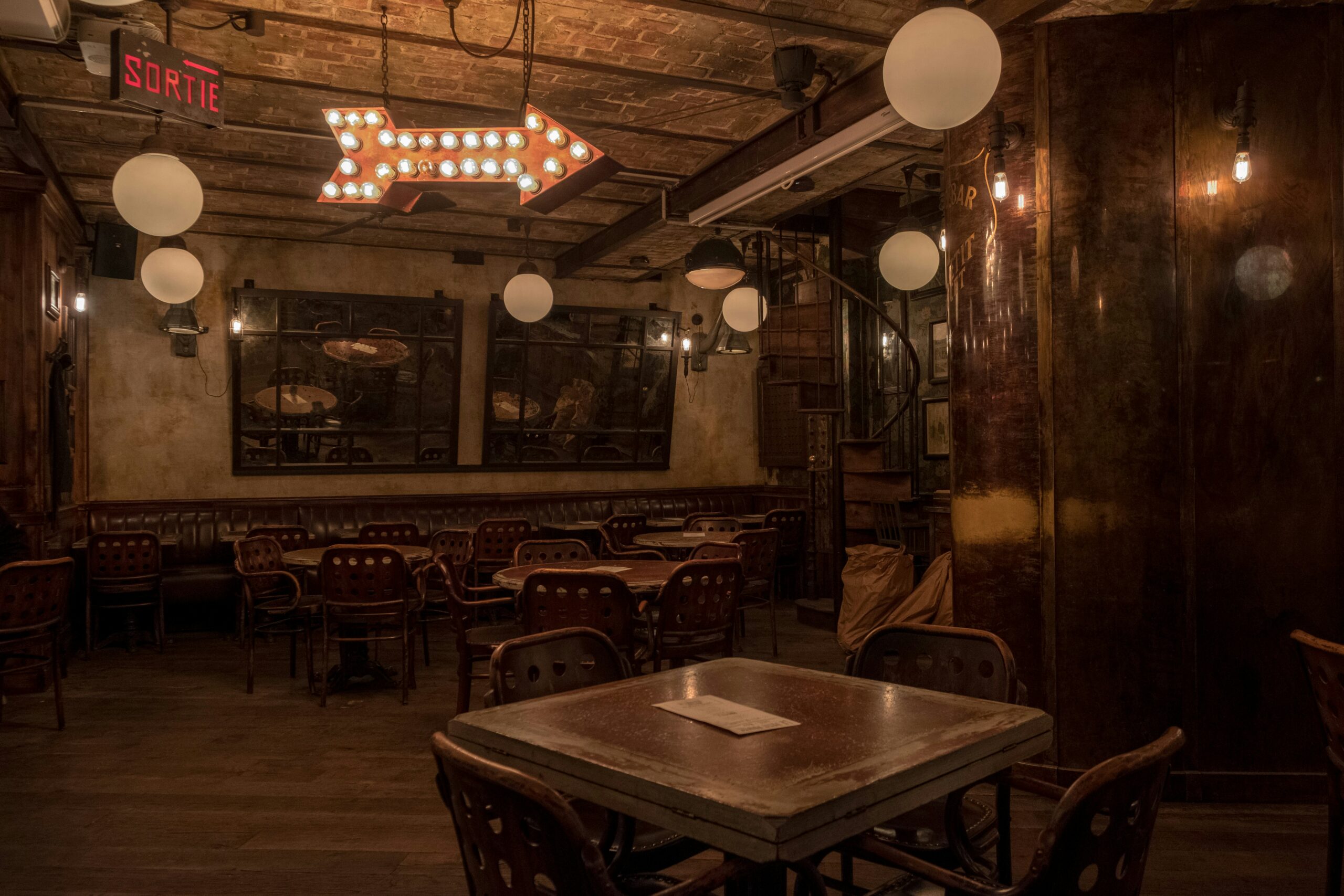
A neon sign blinking “BAR” hung outside but everyone called it the Oak Room. Patrons professed this started as a joke, an irony, a way of saying the old joint in no way resembled The Plaza. Yet a faded grandeur pervaded. Perhaps customers of an earlier era coined the name in genuine appreciation of the saloon’s elegant details. The Oak Room sat on an otherwise desolate block on Third Avenue in the Bronx, near Webster, walking distance from the university. This stubborn tavern remained the lone holdout in a massive federal condemnation lawsuit.
The conquering contractor had vanquished all neighbors.
“Mick,” called a bearded kid. “Pitcher of Bud, please.”
Mickey had the plastic under the tap before the customer finished ordering.
“How’s your meetin’ goin’ today, Johnny?” the bartender asked.
“Getting nothing done,” Johnny said. “Just drinking away the election.”
“I’d reckon that that’s good for me. You boys got a lot of drinkin’ to do.
Mickey placed the pitcher on the bar. “Ya think Carter woulda been better?”
Johnny’s young face wrinkled. “At least he’s not an imperialist.”
Johnny and his friends, seated at the table adjoining the window, led the campus progressive student alliance. Solid regulars, they met every Thursday afternoon over pitchers of beer, plotting the Revolution, or the group’s next lecture, or whatever. Mickey watched them in their dark long coats, with bushy facial hair, as they debated the proletariat’s plight over pitchers of Bud. Idealists for sure, but Mickey wondered sometimes whether they’d wandered in straight from an Engels lookalike contest.
“Well, you boys do what ya think’s right. If ya don’t fight the system, then ya are the system.”
Johnny took the pitcher by the handle. “Perfect pour, Mickey.”
Mickey reached under the bar for some plastic cups. “Can’t fight the man without these, Johnny.”
“Thanks, Mickey.” Johnny winked. “The fight does go on.”
“Hey, son, just don’t end up like Trotsky, ya know, with an ice pick thrust into your backside by your comrades.”
Johnny laughed and reached into his coat pocket. The proprietor waved away the offering.
“Buyback. But remember when you’re writin’ the history, you gotta mention where you planned the Revolution.” Mickey pointed around his joint.
To the discerning eye, the barroom’s elegance remained, and Mickey could still see it all. The bar, chiseled from oak, now bore naked yellow streaks where patrons had leaned for eighty years. The floor appeared to be weary cherry. Chandeliers recovered from doomed Gilded Age mansions hung from the aluminum-square paneled ceiling. Once stylish, these lights, half of their bulbs out, diffused an eerie glint over the place.
“I bought the place before da feds decided booze was a bad thing,” Mickey told patrons. “I’ve been serving from Wilson to Carter, non-stop.”
He preserved the joint like a time capsule, as if some archaeologist would discover the treasure at a future date. Black and white prints of silent movie stars graced the darkening back walls. Only a handful of customers knew why. Mickey didn’t tell the story often but he told it the same every time.
“One night, I gotta friendly reminder from the Dutch Schultz mob that they’d appreciate it if I bought their bootlegged whiskey.”
From under the bar, Mickey would then pull a grainy black-and-white showing rows of bullet holes shot clean through the wall.
“So I did some cost-benefit thinkin’. Ya know what I mean. So I says okay, and Dutch himself thanks me. He says he’ll send a repair crew right up to fix my wall.”
His lips would curl with a nod of the head. “And I’ve had those same posters up ever since.”
Among those special customers who heard the story, there were even a chosen few for whom Mickey would pull up the posters, to let them examine the physical proof.
Another student approached, Billy, a junior from upstate. He arrived two years ago as a freshman, maybe the shyest kid Mickey had ever served. On scholarship, taking honors courses, Billy was a good kid.
“Still Happy Hour, Mick?”
It wasn’t. “Why not?”
“Then two Buds, please, on draft.” Billy gestured to a table where a young woman sat.
As Mickey smiled, his hand clutched the top of the tap as if seeking a pulse.
“I remember when ya were too scared to even talk to a girl.”
Mickey clutched the tap harder as he started the pour. Not all boys are blessed to transform into men during peacetime. Mickey moved his head toward that spot at the far end of the bar before jerking his head back. He finished the second draft and placed it down next to the first.
“Thanks, Mickey.”
“Old men know. Ya can’t fake that smile she’s got,” Mickey said.
Billy blushed a bit.
Mickey grinned. “A keeper! Have your reception here!”
“You’ll still be around?” Billy asked.
“Of course. I threw Jake LaMotta outta here once.” Mickey squatted like a boxer and tossed a one-two. “That bastard contractor won’t know what’s up before it’s over.”
Billy reached toward his back pocket.
“On the house. But whatcha gonna call your first born?” The proprietor pointed toward himself.
True enough, no inventory of the bar’s fixtures should omit Mickey, rooted with the aging oak, as embedded as the bar. Mickey’s craggy features, balding gray, and thin face gave him that timeless old-man appearance. When he removed his dark, thick-rimmed glasses, his blue eyes twinkled. Grinning, specs off, he appeared fifteen years younger.
A disheveled man, mid-fifties, seated at the end emptied his beer glass. He looked at Mickey and drew a breath before speaking.
“Hey Mick, ya know, how ‘bout a Bronx Cocktail? Ya know, the way you do it.”
The bartender grew young in an instant. Once the likes of Ruth, DiMaggio, and LaMotta, among other Bronx luminaries, raved about Mickey’s Bronx Cocktail. It had been his signature drink, famous all over the five boroughs. The New Yorker once published an article about it but Mickey refused to disclose his secrets. He made them hundreds a night — no vodka, no rum, no other substitution allowed. If someone asked for a special order, Mickey would quip he went back so far, he served this exact concoction to Edgar Allan Poe.
“Now don’t you want the very cocktail that Poe demanded?”
Not long ago, at the now abandoned elevated platform, the Third Avenue El stopped several times an hour, delivering crowds to thriving neighborhood stores. Folks from all over the city talked about Mickey’s Bronx Cocktail back then. No trip to Sears or Alexander’s failed to include a stop for a Bronx Cocktail. Or so Mickey believed. People often waited outside for a seat at the bar.
Today, Mickey tended to weekday clientele who favored Budweiser by the pitcher, until the weekends, when the college kids swarmed, ordering beer by the bottle. Mickey never made his famous cocktail anymore, except one for himself every night at closing.
Mickey called back. “Hey Mac, here’s your Bronx Cocktail.”
Mickey enjoyed watching Mac take that first sip more than Mac did taking it.
“That’s fine, Mick.” Mac savored the experience. “Excellent.”
Mac lofted the potion toward Mickey. “To your continued good health, Mick.”
Mick’s throat tightened, and the glass felt heavier. Mickey accepted Mac’s blessing of having lived to a ripe old age. There was no point to a debate.
Years ago, Mickey had purged the saloon of personal effects. He left nothing but that single photograph in that place hidden, at that spot at the end of the bar, more to be present than to be seen. Only the observant would have spotted it, and Mickey’s regulars hardly tended that way. Within the picture’s browning grayscale, the bright eyes of the young man twinkled, as he sat beside a young woman with a beaming young boy on her lap.
The clock struck 5:30 p.m. on an evening far too cold for the first week of November. Daylight Saving Time had ended the prior weekend. Mickey was surprised by how dark it became so early.
Mac, a recent regular, always ordered Bud from the tap. His Bronx Cocktail order came from right field. Mickey had been sizing him up for weeks but never saw that coming.
Mac had never identified himself. Mickey didn’t even know his real name. He called all anonymous customers “Mac.” Still, Mickey had imagined a certain bond with this Mac. He belonged to the Bronx. Mac’s tie, always undone, twisted and reversed, allowing Mickey to spy the brand label — Burberry’s today. He wore a dress shirt of Mulberry silk with a foreign suit that was all the rage in Milan last season.
Mickey recognized quality from his days running the speakeasy, when local pols, hands out but dressed in the finest threads, snuck in the back and demanded to drink for free.
Mac’s blending of high-end British and Italian brands spoke that he had attained expensive taste but lacked genuine style. Mickey didn’t need more proof: twisted British tie, Milan suit, but a Bronx mouth — a local kid “done good.” Yes, a Bronx kid; Mac didn’t quite fit in his exquisitely tailored suits.
Mac gulped down the drink, inhaled and exhaled. He peered down to the far end of the bar, and then toward the posters lining the walls, slurring.
“Another Bronx Cocktail. You make ‘em best.”
Mick surveyed Mac’s glances. “Hey, Mac, over here.” Mickey waved. “I don’t hear so good no more. Gotta look at me when you order, or I can’t hear ya.”
“Another Bronx Cocktail.”
Now Mickey never asked personal questions. Bartending rules being what they are, he took what customers revealed and sought no more. But how did Mac know about his specialty drink?
Mac sipped long from his nearly empty glass, importing pieces of ice into his mouth, extracting every last dash of flavor. An appreciative customer, but who was this guy?
“Hey Mac, ya know, where’d cha hear about my Bronx Cocktail?”
Silence thickened for a moment too long. Mickey inhaled.
“This Reagan guy,” Mac moaned. “He’s a lousy actor. So now we’ve made ‘em President?”
Mickey knew from a lifetime of saloon-keeping that talking politics was bad business. He made a single exception for one group of customers. Mickey could close out taboo discussions before they started. He’d done this thousands of times before.
“I don’t think I’ve seen none of his movies.”
The man winced and, glancing downward, yawned at his empty glass. A sad face appeared.
“Ya know, Billy’d say, when we were kids, everyone raved. ‘Bout your Bronx Cocktail.”
“Billy?”
Mac gazed past Mickey, pointing straight at the photo. “A hero, your boy.”
“You…Billy?”
“Mick, don’tcha recognize me? Tommy Haley. Gun Hill Road. Ya know, Williamsbridge.”
Now that he heard the name, Mickey could see it — fuller, not as happy, the face of his son Billy’s best boyhood friend. Mickey grinned and frowned as one.
Tommy raised his empty glass. “Toast to Billy, and his Gold Star father.”
Mickey lifted his glass, with seltzer, with hesitation, and obliged the salute. How could he not?
“To Billy.”The name coiled in the air like smoke.
Mickey’s gaze wandered toward the faded photograph tacked at the bar’s far end. The boy in the picture looked back, his beam bright and eternal, untouched by the years. Mickey looked at the young woman, holding the boy in her lap. She never got over it. The truth is Mickey never did either. Every night he wiped down the oak until it gleamed. That gave him someplace to go in the morning.
“How’ya, Mickey?” Tommy’s smile twitched. Mickey recoiled. Like in a mirror, Tommy did the same.
“Why you comin’ in here so much, Tommy, never sayin’ your name, or nothin’?”
That look of mum flashed across Tommy’s face as he breathed deep. With the exhale, words came out. “Reagan? Unbelievable!”
Mickey pumped his hands forward but stopped. He instead touched Tommy’s hand, lying flat on the bar’s top. “Stop this Reagan stuff. Just tell me.”
Tommy peered down at his glass, twirled it in circles with his free hand. The ice swirled.
“It’s a God-damned shame, Mickey. Ya know, downtown, this place. It’d be a shrine. You’d get millions for it.”
Mickey’s neck stiffened and his eyes popped. He drew his hand away. In a split second, Mickey replayed those words a thousand times in his head. Every time it pointed to one conclusion. He knew Tommy’s purposes but he couldn’t believe it.
Mickey’s voice twisted. “Be straight, Tommy. Why ya here?”
Tommy looked at the posters and pointed.
“How many people did ya tell about the bullet holes? You said like no one. I remember ya tellin’ us that story like yesterday.”
Mickey remembered the day too. The boys had been out playing baseball but rain cut short their games. Billy brought Tommy to the bar to show off his dad’s place. Mickey regaled them with Prohibition-era stories and plied them with root beers and hamburgers. A lot of rough kids hung around the neighborhood but Mickey had approved of Tommy. He was a reliable friend and a good kid. Tommy had never seen a bullet hole before.
“So you’re comin’ all these times to look at the posters?”
Tommy sat there alone.
“Or ya want me to lift the posters and show ya the holes again?”
Mickey’s glare was the resolute face of a subway conductor closing the doors on a late passenger.
Tommy’s eyes widened. “Whatcha want me to say?”
Mickey didn’t move. “It’s nothin’ I want ya to say. I just wanna answer. Why you comin’ in here Tommy, pretendin’ to be just some regular.”
Mickey waited as the background sounds of the place, the jukebox, the voices, washed over him. He focused on Tommy’s lips. Tommy squirmed to the right, then to the left, and finally moved them.
“Aw, ya figured me already …. I’m with, ya know …”
Tommy’s voice cracked. He swallowed the words. Yet Mickey understood because he already understood.
“… the contractor.”
Mickey’s knees still buckled. “If you got somethin’ to do, go ahead, look me in the eye, and do it.”
Tommy turned away. His eyes misted. He nodded a guilty plea.
“You don’t take their calls. It’s no to every offer. I’m supposed to schmooze you. Settle the eminent domain case.”
Mickey saw the tears. He wanted to relent but emotion swelled. So it came out harsher than he ever could have planned.
“For real? … Tommy Haley? … All grown up, getting’ rich tearin’ down the streets that raised him. Nice boy, that Tommy Haley!”
The words landed just as a blast of the cold November air seeped through the door.
“Mick, no, no. You got me all wrong.”
“That’s so? Then you tell me what this is.”
“It’s just a job. That’s all it was before this.”
“Butcha ain’t quittin’, are ya?”
“I need … ya know … the money.”
With hesitation, one of the bearded students approached for a refill. “Hey Mick, no rush.” He placed the pitcher on the counter.
“Another buyback, my friends. I’ll bring it over,” Mickey said.
Tommy didn’t move. Hands on his forehead, he rubbed his shut eyes with his fingers.
Mickey glared. “So it’s the money, Tommy? Nice, real nice.”
Tommy looked up and slapped two twenties onto the bar to cover his tab, with a generous tip to boot. Mickey waved it away.
“Drinks were on the house. For an old friend.”
“Aw, Mickey, now don’t be like that.” Tommy hung his head. “Not like that. Please, just … just tell me whatcha want.”
Mickey glanced around at a barroom of familiar faces, some long gone. Then the place emptied and he saw a little boy, laughing, running around the tables, daring his enchanting mother, laughing even harder, to catch him. Mickey’s eyes moistened.
Come on, Mick. Just what do ya want …?
— THE END